Showing posts with label Soil Fertility and Fertilizers. Show all posts

Thursday, July 4, 2013

Nutrient Deficiency In the Garden

There are many different symptoms that can show where there has been a nutrient deficiency in a plant. Because all plants respond differently to a lack of nutrients it is not always easy to determine whether it is a deficiency or something else that is causing the changes to the plant.

English: Chlorotic blueberry plant due to soil...
Chlorotic blueberry plant due to soil pH being too high, and therefore plant not being about to uptake iron. (Photo credit: Wikipedia)
Where you see abnormal leaf coloring, where the leaf has turned a pale yellow or changed to a paler color than normal, and the veins of the leaf are green, then this can be a sign of nutrient deficiency.

If the leaves are smaller than normal, or any part of the plant is showing signs of stunted growth, then this is a sure sign of a nutrient deficiency.

There are other signs such as brown blotches on the leaves, but this can also be leaf scorch so you need to consider the conditions that the plant is growing in to help analyze blotchy leaves. If the leaves are showing tones of blue or purple that can be another sign to look out for.

To assist the plant, you should apply a soluble fertilizer, as this will have the fastest effect on its possible recovery.

You will need to check the pH of the soil to see that it is correct and take the appropriate action to remedy the situation if it is out of balance.

The nutrients might be in the soil but without the correct pH balance the plant won't be able to make use of them. Testing can be done with a simple and inexpensive test kit that you can buy from garden stores.

Make sure that the plants you are growing are compatible with the soil that you are growing them in and adjust the type of soil accordingly if you don't want to replace them with plants that can flourish in those conditions.
Enhanced by Zemanta

Tuesday, July 2, 2013

Feeding Your Plants

Just like people, plants have their own particular requirements and it is not the best policy to assume they all need the same feeding. Some plants need a lot of attention whereas others require very little. You can actually harm the growth of your plants by feeding them too much.

Nitrogen Cycle
Nitrogen Cycle (Photo credit: Wikipedia)
Once again there needs to be balance in the garden. If you feed your plants too much fertilizer that is high in nitrogen you might get a lot more foliage but a reduction in the fruit or flowers that the plant will produce. This is because the plants will be using that nitrogen as energy to grow faster rather than produce more fruit or flowers.

Plants are always giving us signs of their food requirements or if they have been stressed. They will wilt, or they might change color, or their leaves might curl up and drop off. If there is something wrong with a plant's nutrition it can often be seen quite easily. It is just a matter of reading these signs and knowing what is going on.

If the leaves of your plants are wilting they might be suffering from a shortage of water. If they're turning yellow there may be an overabundance of water if they are in containers or soil with poor drainage. There might be signs of mold in the soil, which could suggest too much water, and the roots of your plants might be rotting.

As all plants are different, to fully understand the requirements of the particular plants or trees that you are growing you need to get information specific to those plants.

If you find signs of stress in your plants you should take samples to the local nurseries of the leaves and any abnormalities that you might notice in the soil.

The three most important elements in the soil of plants are nitrogen, for the promotion of leaf and stem growth; phosphorus, for the root growth; and potassium, which helps in the growth of flowers and fruits.

If you find there are any deficiencies in these areas then additional nutrients will need to be added to the soil.


Enhanced by Zemanta

Thursday, March 14, 2013

Improving Your Garden Soil With Seaweed

One of the best soil conditioners you can get for your garden is seaweed. What makes seaweed even better for the garden is the fact that it doesn't need to cost you anything if you are prepared to collect it when it gets washed up on the beach, or alternatively from the surface of the water when boating, if you live near the sea.

English: Seaweed Mulch Echoing the old croftin...
Seaweed Mulch. Echoing the old crofting traditions, seaweed is used as a mulch in the garden behind the Tourist Information Office in Lochboisdale. (Photo credit: Wikipedia)
If you don't live near a beach then you can still get the benefits of seaweed in your garden by buying dried seaweed in very affordable packs from many garden centers.

This is the most convenient way to use seaweed on the garden, as it has already been prepared in a state that allows you to spread it evenly throughout the garden. There is the added benefit that the seaweed sold in the stores doesn't smell as much as the seaweed that you would collect from the beach, and it usually has the salt rinsed off already.

Seaweed is also very good as a plant stimulant. It is particularly good for people who are reluctant to use any types of chemicals on the garden, as seaweed is completely safe for the plants, people and also for pets, which makes it ideal for organic gardening.

Many people are unaware that seaweed is also used commercially as it has proven to be a very powerful soil conditioner and in many tests has worked better than some of the manufactured soil conditioners that are commonly sold on the market.

By buying dried seaweed from garden centers you can be assured of the quality and consistency of the product and you can expect results while having the convenience of it being readily available when needed as it will store just fine as long as required. However, if you are concerned about sustainability, of course you will want to collect your own seaweed if if you have access to it.

Seaweed has been used for centuries in gardens around the world and is becoming more popular as people are looking for alternative natural products in preference to chemical-based fertilizer products.

Enhanced by Zemanta

Thursday, February 21, 2013

Video - Creating A Perfect Soil Mix

This short video briefly discusses the soil types graphic we included in Tuesday's post, and demonstrates the creation of an excellent soil mix based on his favorite ratio of ingredients. This would make a great potting soil, and can also be used as garden soil in a new garden space, or as layers in a lasagna garden.

Different Soil Types
Nick Federoff explains the different types of soil, Sand, Silt, and Clay. He talks about his ideal soil mixture and what happens when you mix the different kinds of soil. For more videos and information you can visit Nick online at www.ThingsGreen.TV


Enhanced by Zemanta

Tuesday, September 13, 2011

The Risk of Chemicals - Part 1

We have chemicals in our everyday lives everywhere. Shampoo, toothpaste, many foods, even our clothing all contain or are manufactured with the use of chemicals. Besides polluting the environment, the use of chemicals can be much more threatening. (For more on this, see http://www.newholisticliving.com/toxicload.html, or our Green Living/Toxic Load blog at http://nhltoxicloadgreenliving.blogspot.com/. ) But we’re concentrating on gardening here, and the use of these chemicals on our food. One of the prominent ways chemicals are used in food production is through chemical fertilizers.
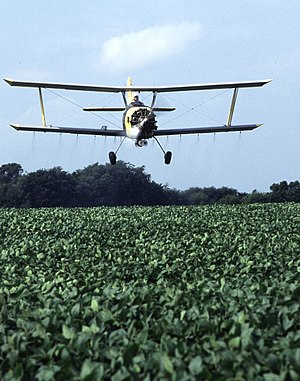
A crop duster flown by Joe Zumalt applies a lo...Image via WikipediaChemical fertilizers are quick-acting, short-term plant boosters and are responsible for:
1. Deterioration of soil friability creating hardpan soil
2. Destruction of beneficial soil life, including earthworms
3. Altering vitamin and protein content of certain crops
4. Making certain crops more vulnerable to diseases
5. Preventing plants from absorbing some needed minerals.

The soil must be regarded as a living organism. An acid fertilizer, because of its acids, dissolves the cementing material, made up of the dead bodies of soil organisms, which holds the rock particles together in the form of soil crumbs. This compact surface layer of rock particles encourages rain water to run off rather than enter the soil.

For example, a highly soluble fertilizer, such as 5-10-5, goes into solution in the soil water rapidly so that much of it may be leached away into our ground water without benefiting the plants at all. This chemical causes the soil to assume a cement-like hardness. When present in large concentrations, they seep into the subsoil where they interact with the clay to form impervious layers of precipitates called hardpan.

Many artificial chemical fertilizers contain acids, as sulfuric and hydrochloric, which will increase the acidity of the soil. Changes in the soil acidity (pH) are accompanied by the changes in the kinds of organisms which can live in the soil. For this reason, the artificial fertilizer proponents tell their customers to increase the organic matter content of their soil or use lime to offset the effects of these acids.
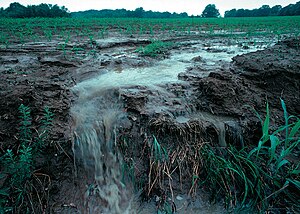
View of runoff, also called nonpoint source po...Image via WikipediaThere are several ways by which artificial fertilizers reduce aeration of soils. Earthworms, whose numerous borings made the soil more porous, are killed. The acid fertilizers will also destroy the cementing material which binds rock particles together in crumbs.

Chemical fertilizers rob plants of some natural immunity by killing off the micro organisms in the soil. Many plant diseases have already been considerably checked when antibiotic producing bacteria or fungi thrived around the roots. When plants are supplied with much nitrogen and only a medium amount of phosphate, plants will most easily contract mosaic infections. Host resistance is obtained if there is a small amount of nitrogen and a large supply of phosphate. Fungus and bacterial diseases have been related to high nitrogen fertilization, and lack of trace elements.

Plants grown with artificial chemical fertilizers tend to have less nutrient value than organically grown plants. For example, several tests have found that by supplying citrus fruits with a large amount of soluble nitrogen will lower the vitamin C content of oranges. It has also been found, that these fertilizers that provide soluble nitrogen will lower the capacity of corn to produce high protein content.

Probably the most regularly observed deficiency in plants treated continually with chemical fertilizers is deficiencies in trace minerals. To explain this principle will mean delving into a little physics and chemistry, but you will then easily see the unbalanced nutrition created in chemical fertilized plants.

We will get into this a little more in our next post, so be sure to check back on Thursday to learn more, including the risks of chemical contaminants in the groundwater, dangers of food poisoning, genetic modifications, and more....

Enhanced by Zemanta